Crypto Coins vs Tokens: What’s the Difference? (Simple Beginner Guide)
Crypto Coins vs Tokens: What’s the Difference? (Simple Beginner Guide)
Four minutes
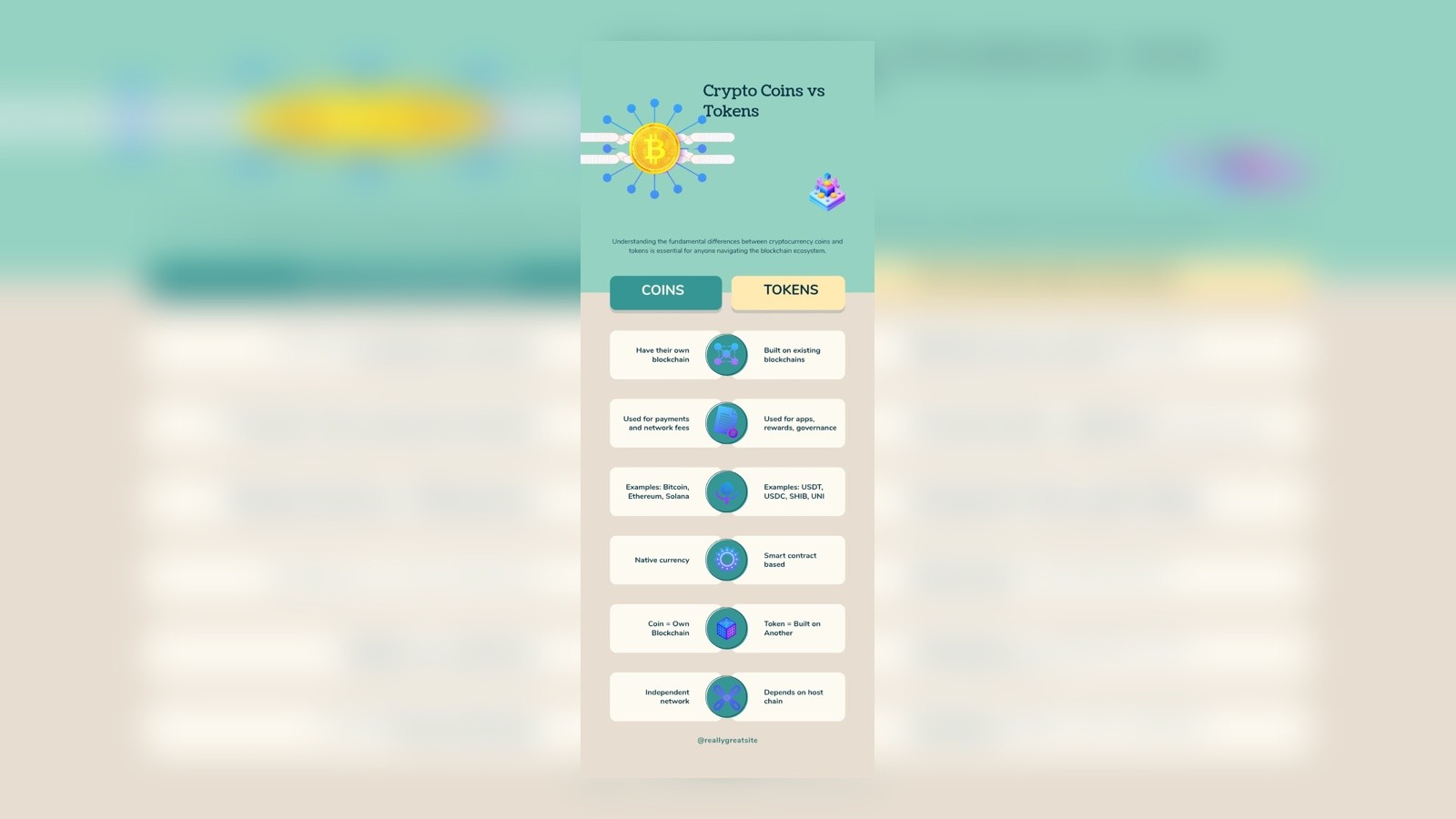
If you are new to cryptocurrency, you have probably heard people use the words "coin" and "token" as if they mean the same thing. They are similar, but they are not exactly the same.
Understanding the difference is important because it helps you understand how crypto works, what you are buying, and why some digital assets are used for payments while others are used inside apps, games, or online projects.
The good news is that the idea is actually very simple.
The easiest way to remember it is this:
A coin has its own blockchain
A token is built on another blockchain
That is the main difference.
What Is a Blockchain?
Before explaining coins and tokens, it helps to first understand what a blockchain is.
A blockchain is like a digital record book shared across many computers around the world. It stores transactions securely and publicly so that people can send and receive digital assets without needing a traditional bank.
Different cryptocurrencies use different blockchains.
For example:
Bitcoin uses the Bitcoin blockchain
Ethereum uses the Ethereum blockchain
Solana uses the Solana blockchain
Each blockchain has its own rules, speed, fees, and system.
You can think of a blockchain as a digital country or operating system where crypto assets live and function.
What Is a Coin?
A crypto coin is a digital currency that runs on its own blockchain.
The blockchain and the coin belong together.
For example:
Bitcoin (BTC) runs on the Bitcoin blockchain
Ether (ETH) runs on the Ethereum blockchain
Solana (SOL) runs on the Solana blockchain
These are coins because they are the main or native currencies of their own networks.
Simple Real-Life Analogy
Think of a blockchain as a country.
The coin is the official money used in that country.
For example:
The United States uses the dollar
The United Kingdom uses the pound
Nigeria uses the naira
In the same way:
The Bitcoin blockchain uses Bitcoin
The Ethereum blockchain uses Ether
The coin is the default currency of that blockchain.
What Do Coins Usually Do?
Coins are mainly used for money-related purposes.
They are often used to:
Send money from one person to another
Store value
Pay network transaction fees
Power and secure blockchain networks
For example:
If you want to send Bitcoin to someone, you use BTC.
If you want to pay transaction fees on Ethereum, you use ETH.
If you want to use the Solana network, you often pay fees with SOL.
Coins are usually the “fuel” that keeps a blockchain running.
Examples of Popular Coins
Here are some well-known crypto coins:
Coin | Token |
|---|---|
Bitcoin (BTC) | Bitcoin |
Ether (ETH) | Ethereum |
Solana (SOL) | Solana |
BNB | BNB Chain |
ADA | Cardano |
All of these are coins because they run on their own blockchains.
What Is a Token?
A token is different.
A token is a crypto asset that is built on top of an existing blockchain instead of having its own blockchain.
This means a project can create a token without building an entirely new blockchain from scratch.
Most tokens are created using smart contracts on blockchains like Ethereum or Solana.
Simple Analogy for Tokens
If a coin is like a country’s official currency, then a token is more like:
A gift card
A movie ticket
A membership card
Reward points
A game voucher
It works inside a specific platform or system.
For example:
A gaming token may let players buy weapons or skins
A voting token may let users vote on project decisions
A stablecoin token may be used for payments and transfers
A loyalty token may reward users for activity
Tokens are usually connected to a particular app, project, or service.
Examples of Popular Tokens
Here are some common examples:
Token | Built on |
|---|---|
USDT (Tether) | Ethereum, Tron, Solana, others |
USDC | Ethereum, Solana, others |
UNI | Ethereum |
SHIB | Ethereum |
LINK | Ethereum |
These are tokens because they depend on another blockchain to function.
For example, SHIB does not have its own blockchain. It runs on Ethereum.
That makes SHIB a token, not a coin.
Why Beginners Often Get Confused
Many beginners think:
“If it is popular, then it must be a coin.”
But popularity does not decide whether something is a coin or token.
The structure decides.
For example:
Bitcoin is a coin
Ethereum is a coin
USDT is usually a token
SHIB is a token
Even though USDT is used like money every day, it is still a token because it runs on other blockchains.
Practical Example: Coins vs Tokens in Everyday Crypto Use
Imagine three people:
Example 1: Sending Money
John wants to send money to his brother in another country.
He uses Bitcoin.
Bitcoin works mainly as digital money.
BTC is a coin.
Example 2: Using a Crypto App
Sarah joins a decentralized finance app where users vote on platform decisions.
She receives UNI tokens.
UNI is used inside that project for governance and voting.
UNI is a token.
Example 3: Playing a Blockchain Game
David plays an online blockchain game.
The game rewards him with special gaming assets that can buy weapons and upgrades.
Those gaming assets are usually tokens.
Why Tokens Became So Popular
Creating a new blockchain is difficult, expensive, and time-consuming.
But creating a token is much easier.
Instead of building an entire blockchain, developers can simply use an existing one like Ethereum.
This saves time and money.
That is why many crypto startups launch tokens instead of coins.
What Are Stablecoins?
Stablecoins are crypto assets designed to keep a stable value, usually linked to a real-world currency like the US dollar.
Examples include:
USDT
USDC
These are usually tokens, not coins.
For example:
USDT can run on Ethereum
USDT can also run on Tron
USDT can also run on Solana
The same token can exist on multiple blockchains.
That is another reason it is called a token.
Feature | Coin | Token |
|---|---|---|
Has its own blockchain? | Yes | No |
Built on another blockchain? | No | Yes |
Main use | Money and network fees | Specific apps and projects |
Example | Bitcoin | USDT |
Analogy | National currency | Gift card or membership card |
Why This Matters for Crypto Users
Understanding the difference between coins and tokens helps you:
Understand crypto projects better
Avoid beginner confusion
Know what you are buying
Understand how crypto apps work
Learn why some assets are used mainly for payments while others are used inside platforms
This is especially important when converting crypto to cash.
Some assets are mainly designed for payments and transfers, while others are tied to specific projects, games, or ecosystems.
Even though both coins and tokens can often be converted into cash, they may serve very different purposes in the crypto world.
The Simplest Way To Remember It
If you forget everything else, remember this:
Coin = runs on its own blockchain
Token = built on another blockchain
Or even simpler:
A coin is the main money of a blockchain.
A token is a digital asset created inside another blockchain system.
Final Thoughts
Crypto can seem complicated at first, but many concepts become easier once you break them down into simple ideas.
Coins and tokens are both digital assets, but they are built differently and often serve different purposes.
Coins usually power blockchains and act like digital money.
Tokens are usually created for specific apps, services, communities, games, or projects.
Knowing the difference helps you understand the crypto world more clearly and makes you a smarter crypto user from the very beginning.
If you are new to cryptocurrency, you have probably heard people use the words "coin" and "token" as if they mean the same thing. They are similar, but they are not exactly the same.
Understanding the difference is important because it helps you understand how crypto works, what you are buying, and why some digital assets are used for payments while others are used inside apps, games, or online projects.
The good news is that the idea is actually very simple.
The easiest way to remember it is this:
A coin has its own blockchain
A token is built on another blockchain
That is the main difference.
What Is a Blockchain?
Before explaining coins and tokens, it helps to first understand what a blockchain is.
A blockchain is like a digital record book shared across many computers around the world. It stores transactions securely and publicly so that people can send and receive digital assets without needing a traditional bank.
Different cryptocurrencies use different blockchains.
For example:
Bitcoin uses the Bitcoin blockchain
Ethereum uses the Ethereum blockchain
Solana uses the Solana blockchain
Each blockchain has its own rules, speed, fees, and system.
You can think of a blockchain as a digital country or operating system where crypto assets live and function.
What Is a Coin?
A crypto coin is a digital currency that runs on its own blockchain.
The blockchain and the coin belong together.
For example:
Bitcoin (BTC) runs on the Bitcoin blockchain
Ether (ETH) runs on the Ethereum blockchain
Solana (SOL) runs on the Solana blockchain
These are coins because they are the main or native currencies of their own networks.
Simple Real-Life Analogy
Think of a blockchain as a country.
The coin is the official money used in that country.
For example:
The United States uses the dollar
The United Kingdom uses the pound
Nigeria uses the naira
In the same way:
The Bitcoin blockchain uses Bitcoin
The Ethereum blockchain uses Ether
The coin is the default currency of that blockchain.
What Do Coins Usually Do?
Coins are mainly used for money-related purposes.
They are often used to:
Send money from one person to another
Store value
Pay network transaction fees
Power and secure blockchain networks
For example:
If you want to send Bitcoin to someone, you use BTC.
If you want to pay transaction fees on Ethereum, you use ETH.
If you want to use the Solana network, you often pay fees with SOL.
Coins are usually the “fuel” that keeps a blockchain running.
Examples of Popular Coins
Here are some well-known crypto coins:
Coin | Token |
|---|---|
Bitcoin (BTC) | Bitcoin |
Ether (ETH) | Ethereum |
Solana (SOL) | Solana |
BNB | BNB Chain |
ADA | Cardano |
All of these are coins because they run on their own blockchains.
What Is a Token?
A token is different.
A token is a crypto asset that is built on top of an existing blockchain instead of having its own blockchain.
This means a project can create a token without building an entirely new blockchain from scratch.
Most tokens are created using smart contracts on blockchains like Ethereum or Solana.
Simple Analogy for Tokens
If a coin is like a country’s official currency, then a token is more like:
A gift card
A movie ticket
A membership card
Reward points
A game voucher
It works inside a specific platform or system.
For example:
A gaming token may let players buy weapons or skins
A voting token may let users vote on project decisions
A stablecoin token may be used for payments and transfers
A loyalty token may reward users for activity
Tokens are usually connected to a particular app, project, or service.
Examples of Popular Tokens
Here are some common examples:
Token | Built on |
|---|---|
USDT (Tether) | Ethereum, Tron, Solana, others |
USDC | Ethereum, Solana, others |
UNI | Ethereum |
SHIB | Ethereum |
LINK | Ethereum |
These are tokens because they depend on another blockchain to function.
For example, SHIB does not have its own blockchain. It runs on Ethereum.
That makes SHIB a token, not a coin.
Why Beginners Often Get Confused
Many beginners think:
“If it is popular, then it must be a coin.”
But popularity does not decide whether something is a coin or token.
The structure decides.
For example:
Bitcoin is a coin
Ethereum is a coin
USDT is usually a token
SHIB is a token
Even though USDT is used like money every day, it is still a token because it runs on other blockchains.
Practical Example: Coins vs Tokens in Everyday Crypto Use
Imagine three people:
Example 1: Sending Money
John wants to send money to his brother in another country.
He uses Bitcoin.
Bitcoin works mainly as digital money.
BTC is a coin.
Example 2: Using a Crypto App
Sarah joins a decentralized finance app where users vote on platform decisions.
She receives UNI tokens.
UNI is used inside that project for governance and voting.
UNI is a token.
Example 3: Playing a Blockchain Game
David plays an online blockchain game.
The game rewards him with special gaming assets that can buy weapons and upgrades.
Those gaming assets are usually tokens.
Why Tokens Became So Popular
Creating a new blockchain is difficult, expensive, and time-consuming.
But creating a token is much easier.
Instead of building an entire blockchain, developers can simply use an existing one like Ethereum.
This saves time and money.
That is why many crypto startups launch tokens instead of coins.
What Are Stablecoins?
Stablecoins are crypto assets designed to keep a stable value, usually linked to a real-world currency like the US dollar.
Examples include:
USDT
USDC
These are usually tokens, not coins.
For example:
USDT can run on Ethereum
USDT can also run on Tron
USDT can also run on Solana
The same token can exist on multiple blockchains.
That is another reason it is called a token.
Feature | Coin | Token |
|---|---|---|
Has its own blockchain? | Yes | No |
Built on another blockchain? | No | Yes |
Main use | Money and network fees | Specific apps and projects |
Example | Bitcoin | USDT |
Analogy | National currency | Gift card or membership card |
Why This Matters for Crypto Users
Understanding the difference between coins and tokens helps you:
Understand crypto projects better
Avoid beginner confusion
Know what you are buying
Understand how crypto apps work
Learn why some assets are used mainly for payments while others are used inside platforms
This is especially important when converting crypto to cash.
Some assets are mainly designed for payments and transfers, while others are tied to specific projects, games, or ecosystems.
Even though both coins and tokens can often be converted into cash, they may serve very different purposes in the crypto world.
The Simplest Way To Remember It
If you forget everything else, remember this:
Coin = runs on its own blockchain
Token = built on another blockchain
Or even simpler:
A coin is the main money of a blockchain.
A token is a digital asset created inside another blockchain system.
Final Thoughts
Crypto can seem complicated at first, but many concepts become easier once you break them down into simple ideas.
Coins and tokens are both digital assets, but they are built differently and often serve different purposes.
Coins usually power blockchains and act like digital money.
Tokens are usually created for specific apps, services, communities, games, or projects.
Knowing the difference helps you understand the crypto world more clearly and makes you a smarter crypto user from the very beginning.